Pop quiz: What kind of natural habitat is increasing in urban areas? This is not a trick question. Rather, the answer offers a slice of good news on a planet that has been increasingly turning from green to gray.
Kelly Ksiazek-Mikenas, Ph.D., in the Plant Science Lab
Dr. Ksiazek-Mikenas, a former biology teacher, spent six years studying these engineered habitats and their potential to support biodiversity.
The plant scientist is now eager to share her findings: When started carefully and with a long-term plan in mind, these sites do grow up to support species, natural communities, and genetic diversity.
“When you have these three pieces working, you have a good foundation that should sustain plant life over long periods of time and live through environmental changes, and that look and function like a diverse prairie,” she said.
Dr. Ksiazek-Mikenas examined shallow (up to six inches of soil depth), low-moisture roofs from Glencoe, Illinois, to Neubrandenburg, Germany, before reaching that conclusion. While the roofs within the United States are generally younger, some in her German sites were up to 93 years old, providing a mix of data about green roofs at all ages. She also studied data sets and conducted shorter-term experiments to clarify the qualities green roofs need to succeed.
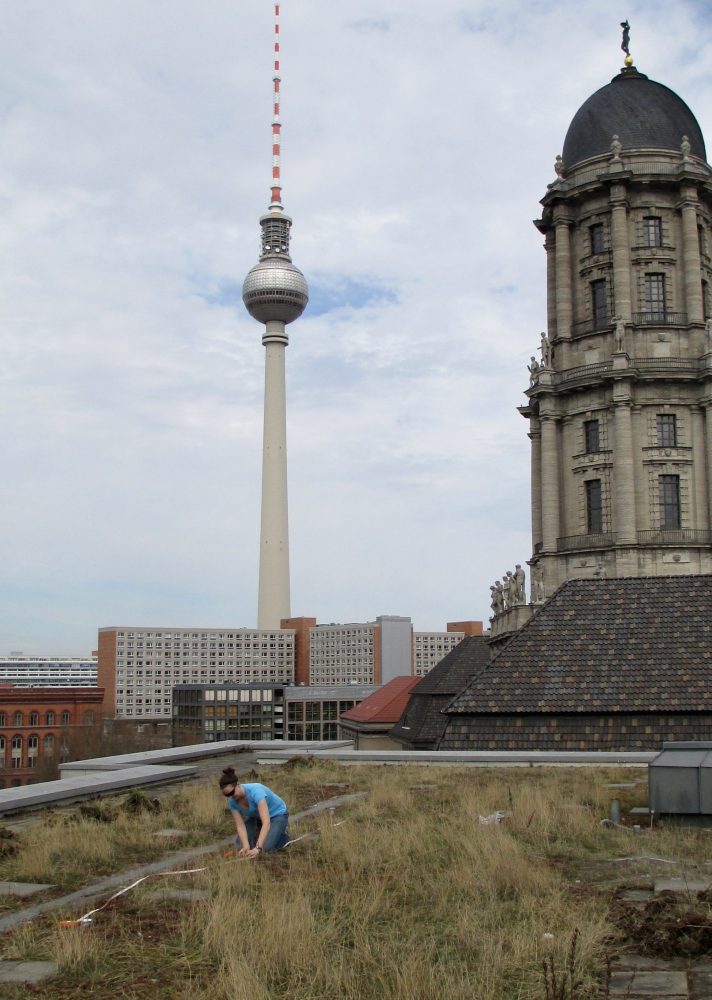
Dr. Ksiazek-Mikenas sets up insect traps in 2013 on a green roof in downtown Berlin.
Her work had its ups and downs. She arrived in Germany looking for similarities, expecting the insect and plant species on one roof to mirror that on the others. Rather, she found differences between roof gardens. After a deep dive into data, she found the secret. Although the plant species differed between gardens, those that grew well shared the traits of being stress-tolerant and adept at establishing themselves in new areas.
She was concerned by the lack of diversity on individual roof gardens both in Germany and in her study sites in Chicago.
Back at the Chicago Botanic Garden, she set up an experiment to test how different soil types would affect which plants were successful, and whether she could create a more diverse community on one rooftop by planting both rock and sand prairies.
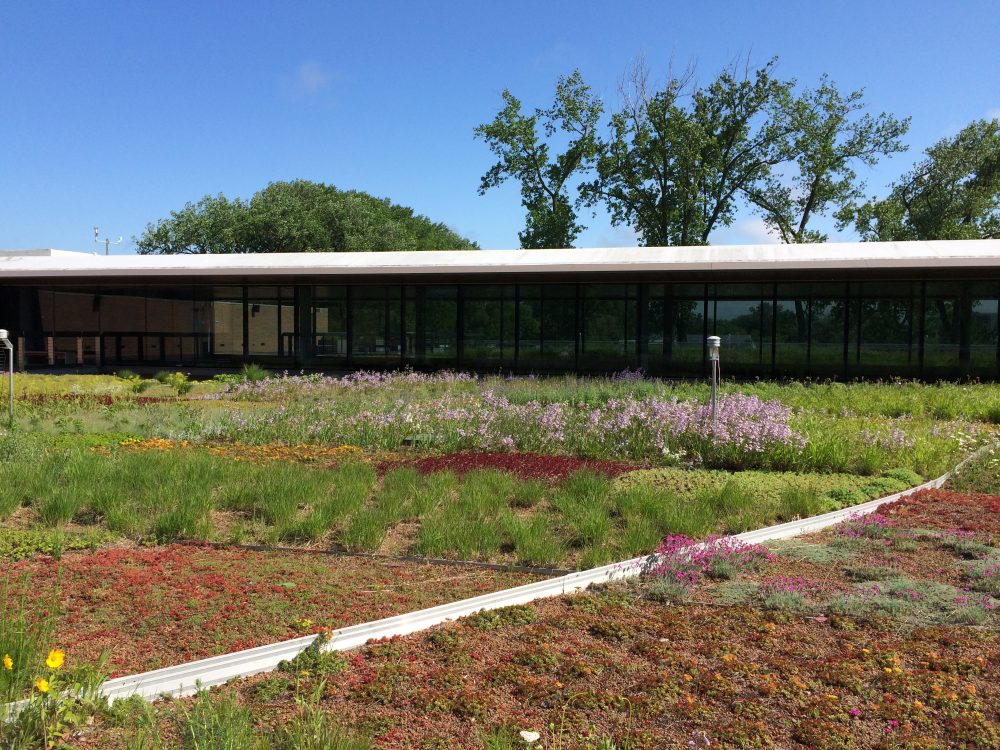
She planted her experimental plots on the Josephine P. & John J. Louis Foundation Green Roof Garden North on the Daniel F. and Ada L. Rice Plant Conservation Science Center and monitored activity over three years. She found success in growing a more diverse habitat. In related work at the same site, she confirmed that native plantings, rather than the common sedum plant mix used on roof tops, offered benefits similar to a native prairie when it comes to storing rainwater, for example.
The Plant Science Center’s Green Roof Garden is an important resource. Planted in 2009, it serves as a living laboratory, classroom, research site, and a source of inspiration to visitors.
A blooming population of Penstemon hirsutus was part of Dr. Ksiazek-Mikenas’ experiments.
She then expanded to include plots on the Ellis Goodman Family Foundation Green Roof Garden South to study genetic diversity. She compared the genetic diversity of populations established from nursery stock to natural populations, finding more diversity in the natural populations grown from wild collected seed.
On the heels of that finding, she studied populations on green roofs in Chicago near Lake Michigan to find out if the plants were able to share their genetic material with plants on neighboring roofs through pollination. She was thrilled to confirm that they did, as the exchange of diverse genetic material is essential for the long-term health of a species.
Although there are limitations to green roof gardens, mainly due to the lack of soil depth and disconnected setting, Dr. Ksiazek-Mikenas is optimistic about their ability to sustain native species. She has presented her work at numerous conferences across the globe to academics and those in the landscaping industry.
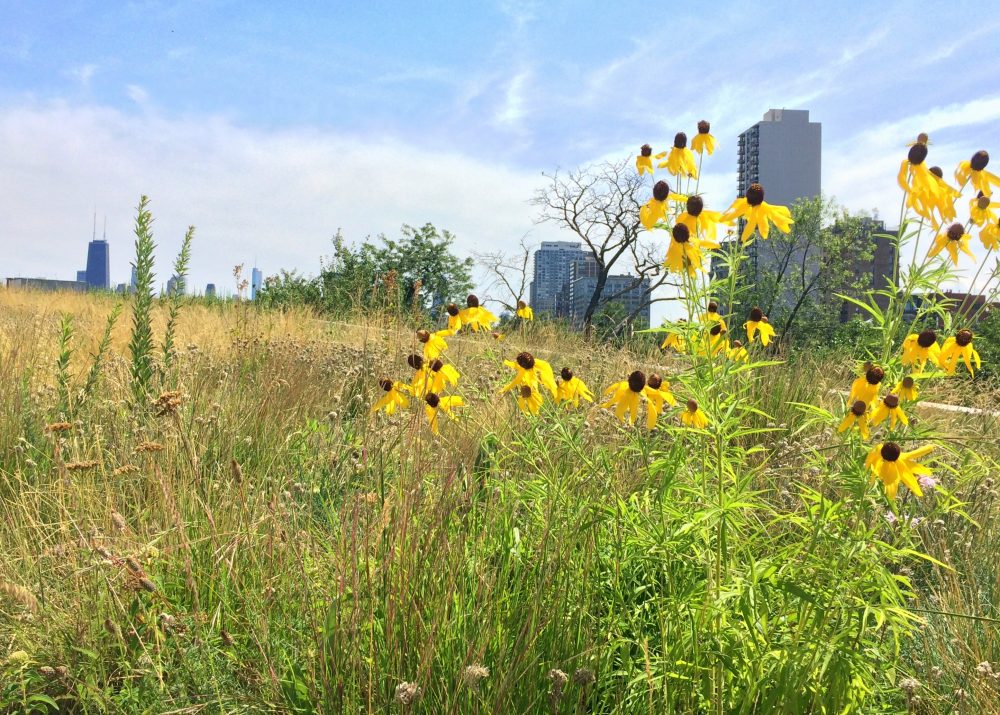
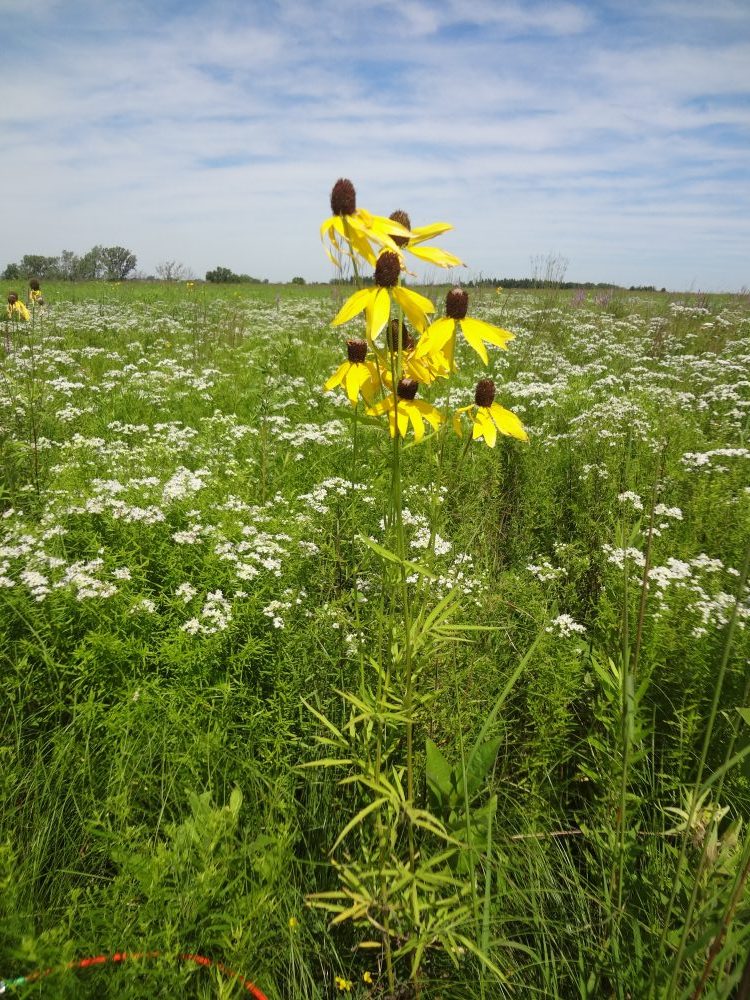
Two prairie species in Dr. Ksiazek-Mikenas’ experimental plots—Ratibida pinnata (foreground, right) and Lespedeza capitata (background, left)—bloom on a green roof on the Peggy Notebaert Nature Museum in Chicago.
“In the future, I hope that green roofs can continue to provide ecosystem services to people but also increasingly support a wide variety of urban biodiversity,” she said.
The motivated researcher is ready to move ahead with her career and intends to continue to bring her unique perspective to future students and to the development of more green infrastructure in this growing world.
Inspired by the plants and insects in their garden, jewelers Roberta and David Williamson will be among 145 artists from across the country showing their handcrafted work this week at the American Craft Exposition (ACE). The juried exposition at the Chicago Botanic Garden is also a fundraiser for the Auxiliary of NorthShore University HealthSystem.
Roberta recalls the early days of her work, when, shortly after her daughter was born, she peered out the window and observed a mother bird feeding its young. She marveled at its instinctual behavior and how the scene symbolized her own experience. The artist was inspired to create a series of charms for necklaces depicting stories of nature such as that one, which she later told to her young child. “I always see those kinds of connections between people and nature and how inspiring that is,” she said.
It is that type of inspiration that has energized her work each year, leading to new creations that she and David craft with much thought and care. “We are great observers of nature and incorporating that into the work,” she noted. “People who collect our work come year after year and we think about them as we are creating the work, and know who will love which piece…they are growing with us and that’s amazing.”
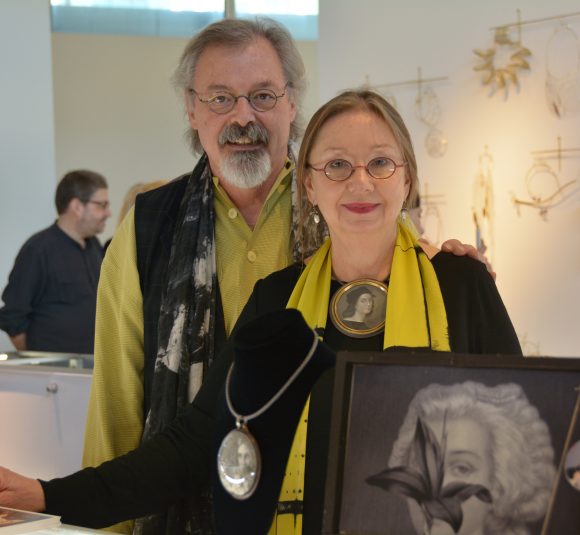
Dave and Roberta Williamson
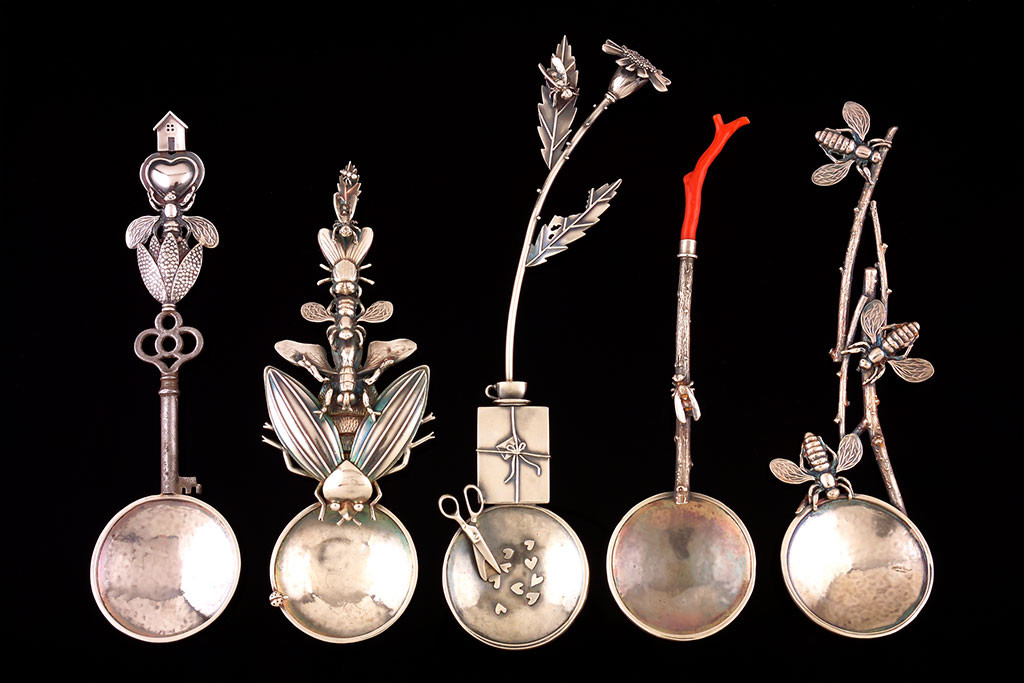
Based in Ohio, the Williamsons are also professors of art at a liberal arts college near Cleveland. The natural-born teachers enjoy sharing the stories of their art with students and visitors to ACE. At home, they are avid gardeners, working across their one-acre property as much as possible to plant urns and work with their favorites—foliage and flowers. “We plant and really enjoy that process,” said Roberta. “We are passionate about it and just being so in touch with nature, we bring that to the work. Many of our pieces are about plants and the insects that inhabit the garden.”
As much as nature enhances their work, the jewelers also find inspiration in other sources. “I think besides the garden and any insects and birds, the other part that we are really interested in is antique etchings, but primarily the early costumes of royalty and the embellishment on the clothing that they wear,” said Roberta. Both interests can be seen in much of the body of work they create each year.
Just as their own stories have evolved over the years, such as Roberta finding a love of nature after moving from Chicago to the suburbs as a child, the story of each piece of their jewelry evolves from the time they begin to create it to the life it takes on when it is in the hands of a new owner.
ACE cannot come soon enough for the couple, who are energized by the atmosphere of the event, the presence of their fellow artists, the event committee, and the lush setting of the Garden. “I just hope that a lot of people will be able to come to see how spectacular the combination of the art in the show is beside the Botanic Garden. I think their spirits will be so lifted that it will be really magical,” Roberta said.
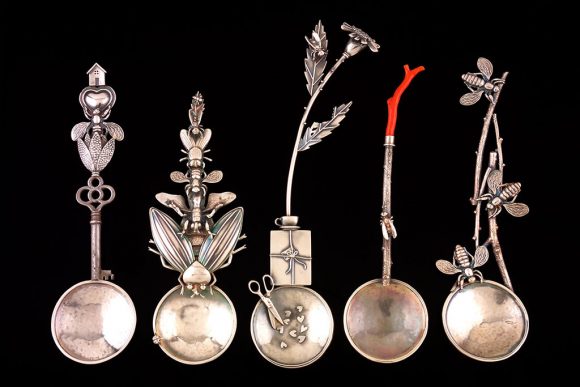
Roberta & David Williamson, Abundance, 2010. James Beards photograph, via craftinamerica.org
The American Craft Exposition opens with a Benefit Preview on Thursday, September 14, and is open to the public Friday through Sunday, September 15 to 17. Proceeds from ticket sales support research into orthopaedic regenerative medicine and pharmacogenomics, or how changes in one’s DNA affect the way the body responds to medication.
Home gardeners can sympathize: not every seed that is planted grows.
This truth extends to restored prairies that are grown from seed mixes, according to Rebecca Barak, Ph.D., who completed research this year examining the success of individual species within seed mixes, and their combined potential to power up to the diversity level found in remnant prairies.
A healthy, diverse prairie
Urban and agricultural development has left us with less than one-tenth of one percent of prairieland, which is vital part of our ecosystem. Today, the prairie can be found only in small patches, and scientists at the Chicago Botanic Garden study prairie plants and their chance for survival amid changing climates and landscapes. For Dr. Barak, a key question is what restored plant communities will look like.
Restored prairies can and do grow in all kinds of places, according to Barak, who conducted fieldwork at dozens of sites within an hour or two of Chicago. From a small playfield behind a nature center to the grounds of a temple to a large swath of acreage in the suburbs, she and her team visited each restored prairie site to compare the plant communities to the mix of seeds that were planted there initially.
“I studied that on the ground—how do prairies differ, how do seed mixes become prairies, and how can we tweak those seed mixes to improve diversity outcomes for restored prairies,” explained Barak, who recently earned her doctoral degree from the Chicago Botanic Garden and Northwestern University and is now a post-doctoral researcher in a joint appointment between the Garden and Michigan State University.
To conduct her fieldwork, she outlined a 50-meter-long transect in each study prairie, and marked off a large circle every 5 meters along the way. Within the circle, she and her collaborators counted all the plant species they could find. They compared those notes to a walk-through of each site months later as bloom cycles changed.
A native of the Chicago suburbs, Barak made unofficial discoveries that warmed her prairie-loving heart.
“I’ve lived here almost all my life and there were all these preserves that I didn’t know about,” she said. Small corners of the city were transformed into lush green spaces, such as the Burnham Wildlife Corridor. Suburban sites such as Orland Grassland were larger and more delightful each season than she anticipated.
After summer months spent documenting and counting, she compared the list of existing plants to the list of seeds that were planted from the original seed mix. She found that less than 50 percent of the species diversity survived from seed to plant. “A lot of species are lost along the way,” she noted.
The plant mix within the restored prairies was then compared to historical data from 41 remnant prairies across Illinois—sites that had never been altered for other purposes. In addition to her findings about the success rate of seeds planted in restored prairies, “I found that species in restored prairies are more closely related to one another than species in remnant prairies,” said Barak.
The David H. Smith Conservation Fellow is not only tuned in to the number of species found in each prairie, but also to how well they represent a variety of evolutionary threads. “We think about how spread out plants in the prairie are across the evolutionary tree of life. Maybe, if you are getting more branches on the tree, your community will function better, or differently,” she noted.
“When we look at remnant and restored prairies, we find that there are differences in biodiversity and there are opportunities to increase diversity of restored prairies. In order to do that we have to think about the seed mixes that are being used,” she added.
In doing so, Barak anticipates that a higher level of diversity will support more functions like serving as habitat for pollinators.
Her detailed findings will be published this August in the Journal of Applied Ecology.
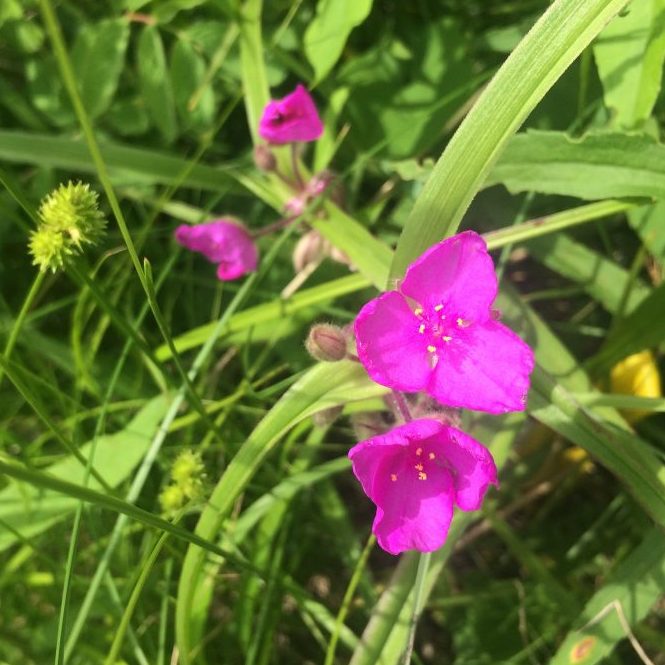
Spiderwort (Tradescantia)
In addition to the benefits of prairies—such as storing rainwater and carbon dioxide—they also provide opportunities we can all enjoy each time we visit, said the scientist and former teacher. “I think it’s about more than that [the ecological benefits]—it’s about teaching people our natural heritage, thinking about habitats that are unique and special to our area, getting people to notice biodiversity, and recognizing that it can even happen in the city or suburbs.”
On a walk through the Chicago Botanic Garden, you are likely to encounter dozens of woody plants—short, tall, flowering, or simply lending structural beauty to a landscape. It’s OK to have a favorite. Phillip Douglas, the Garden’s new curator of woody plants, is not shy about listing his top picks.
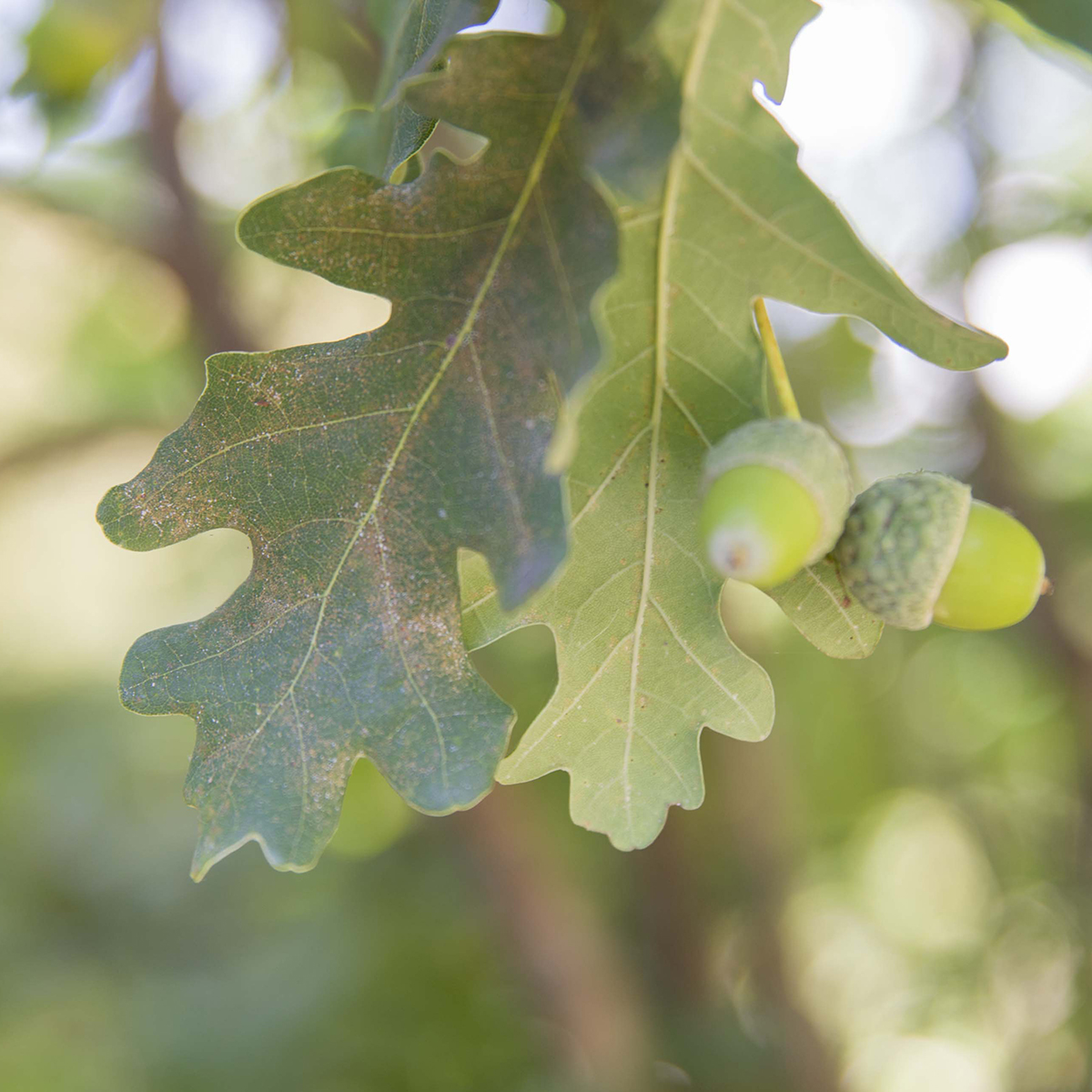
Spending his first summer in Glencoe, Douglas is especially taken with the variety of oaks at the Garden. The horticulturist points out the deep purple leaves on the English oak tree (Quercus robur ‘Purpurascens’) in the meadow east of the English Walled Garden, and the cutleaf emperor oak (Quercus dentata var. pinnatifida) growing near the road south of the Regenstein Learning Campus.
The deep purple leaves of the English oak tree (Quercus robur ‘Purpurascens’)
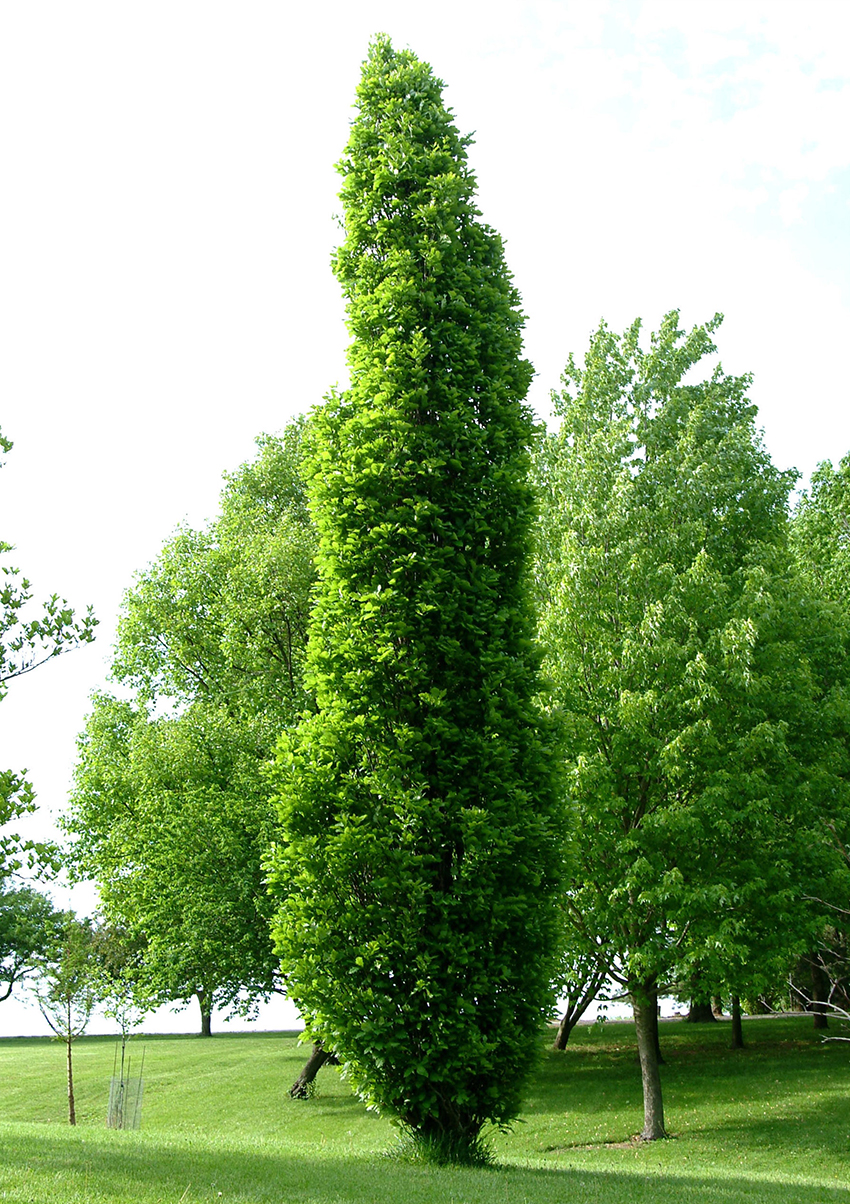
He favors the narrow, upright Regal Prince oak (Quercus × warei ‘Long’)—in the rainwater glen on the southeast corner of the Daniel F. and Ada L. Rice Plant Conservation Science Center—for smaller landscapes. He describes Regal Prince as a hybrid oak that is columnar in shape. Along with a similar hybrid, Kindred Spirit (Quercus × warei ‘Nadler’), it is readily available in nurseries. “The big push in the industry now is hybrid oaks that are fastigiate (column-like) trees,” he explained. “If someone would like an upright oak in a home landscape, either is a good option to consider.”
Kindred Spirit hybrid oak (Quercus × warei ‘Nadler’). Photo by Joshnadler [Public domain], via Wikimedia Commons.
Douglas credits his fascination with the oak species as his entry point into the field of horticulture. During an internship at the Boone County Arboretum in Kentucky, “I started getting interested in oaks, started collecting oaks for my house, and the obsession grew from there,” he said. The outdoors has always been a part of his life, from growing up in Kentucky close to water and woods, to his years as a Marine. His transition into horticulture felt natural, he said.
Douglas is eager to share his knowledge with Garden visitors and to help build the woody plants collection.
“Woody plants fulfill such a role for us and for the environment,” he said. “They provide so much for us, and they really fulfill an important niche in our landscapes.” The benefits of such plants include providing shade, reducing storm water runoff, and providing habitat for animals and insects.
“Oak is an incredibly enormous, diverse genus,” Douglas said. “There are about 500 species that grow all over the world. You can have anything from a very small shrub to large trees that can be thousands of years old.”
Among his first projects are the development of the oak and willow collections, and a review of all such plants already on-site.
Douglas will also be helping to organize trips to collect plants in the wild with Andrew Bunting, assistant director of the Garden and director of plant collections. Collecting trips are planned for the summer and then fall to domestic and international locations with similar growing climates to Chicago.
“Both his passion and previous collecting experiences will be immediately useful in two collecting trips Phil is helping coordinate to Kentucky and Tennessee and Azerbaijan,” said Bunting, who was delighted to welcome Douglas to his team in April. “Phil Douglas has been a wonderful addition to the collections teams at the Chicago Botanic Garden. He brings extensive woody plant knowledge to the Garden, especially with the genera Magnolia, Quercus, and Populus.”
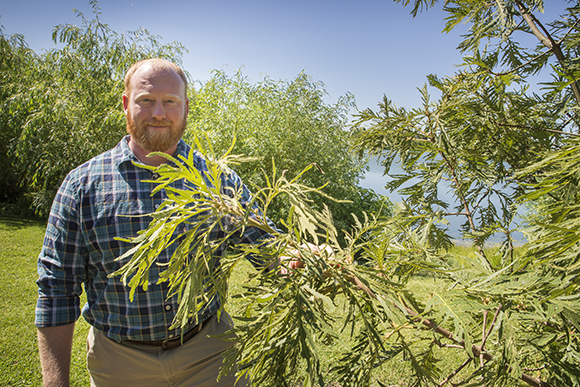
The Garden’s new curator of woody plants, Phillip Douglas.
Back in his office in the Horticulture Building, Douglas is surrounded by plans for the near future. On the desk sit outlines for wild-collecting trips. Just outside of his window, construction continues on a new garden. His first months in Glencoe have been both overwhelming and energizing. “I like the variety of the things that I get to do, and I’m excited to help develop the collections and to add to the Garden,” he said.
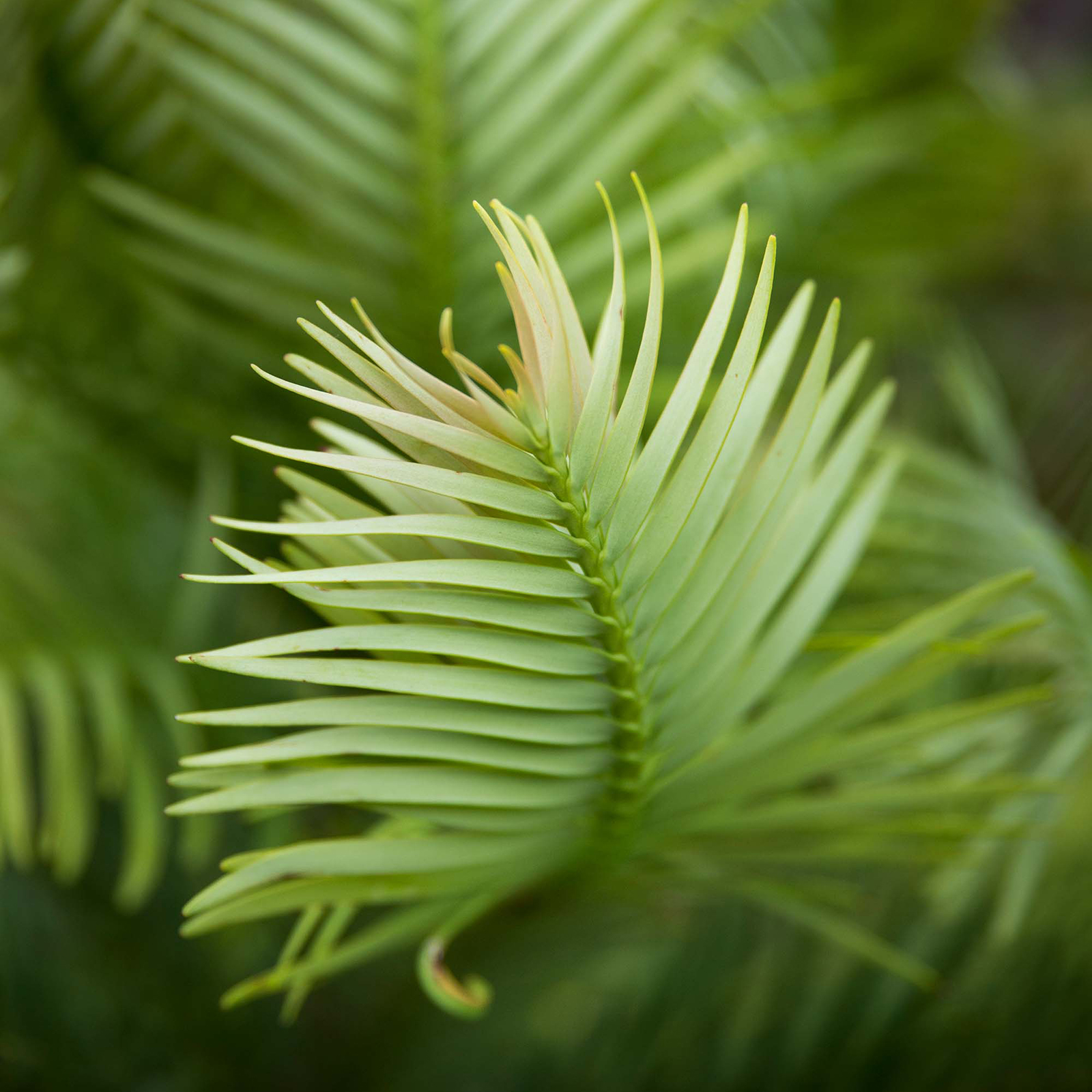
The dinosaur of the plant kingdom, a Wollemia pine tree (Wollemia nobilis), has surprised horticulturists at the Chicago Botanic Garden with a burst of promising male and female cones this winter.
In Glencoe, the sole tree spends its winters in the carefully controlled environment of the production greenhouse. In the wild, its relatives are clinging to life on remote sandstone gorges in the Blue Mountains of Australia.
“It is probably the most watched plant in the Garden right now,” said Boyce Tankersley, director of living plant documentation. Little is known about the prehistoric species that is part of a genus dating back 65 million years. The Garden’s specimen is a youthful 8 years old, and is just beginning to show off its unusual characteristics.
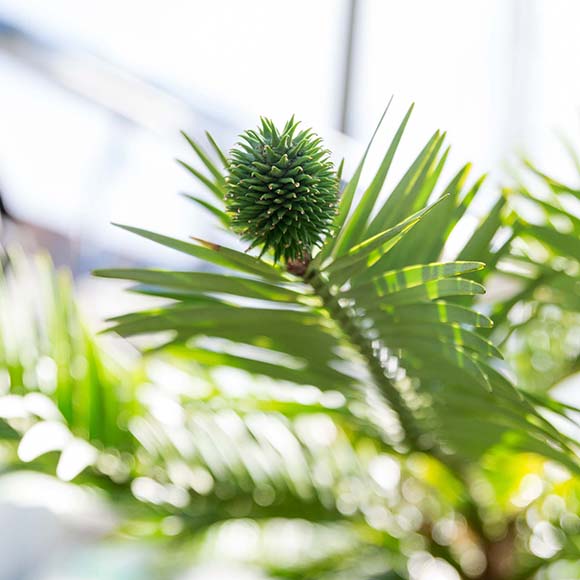
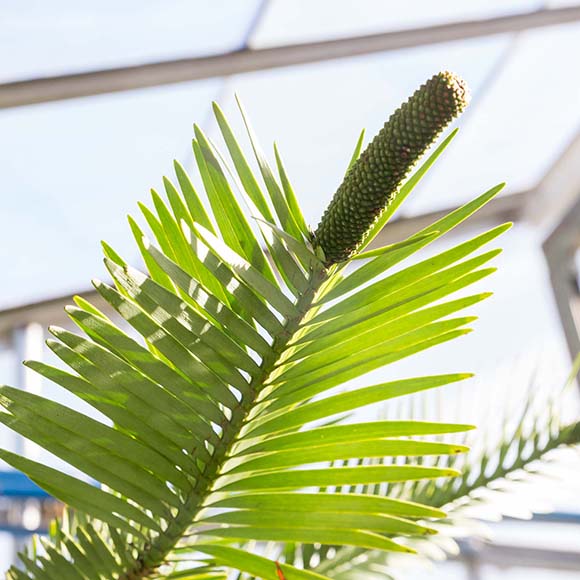
“In this case, there is such little information in the literature,” noted Tankersley, who was amazed to see both male and female cones emerging from the tree’s branches earlier this year. “We don’t know enough about this plant to know if it is going to set seed…but at least it is producing cones, which will allow us to try some experiments,” he said. The tree has grown male cones in recent years, but this is the first year it has produced any female cones.
Wollemia nobilis female cone
Wollemia nobilis male cone
Scientists do know that the species that has managed to survive the test of time possesses some unusual adaptations. It can generate new seedlings by dropping specific branches that take root, or it can exchange pollen from male to female cones to generate seed.
At the Garden, scientists plan to pollinate the tree when the time is right. They will use pollen from the tree itself, and if available, pollen from a tree at another botanic garden. They will also reserve pollen for a potential future exchange.
Find Wollemia nobilis in the Heritage Garden in the summer months.
Trees in the wild population are believed to be closely related to one another. As a result, any seeds they produce have a low level of viability. Only 6 percent or fewer go on to become healthy, mature trees. The species is listed as critically endangered. The urgency to save the pines is accelerated by changes in climate. Their mountain home is experiencing increasingly hotter and drier weather than ever before.
According to Tankersley, there is hope that more diversity may be found within the propagated plants, and that their offspring could lead to a stronger future for the species. However, scientists are only mildly optimistic. “In a world where there is so much that we can’t do anything about, it’s good to have something where you can participate in efforts to keep something from going extinct,” he said. “This plant is not gone; there’s something we might be able to do to help it out.” In addition, the plant may inform the research of paleobotanists who rarely have the opportunity to see a live plant with such historic roots to compare against the fossil record. “In a scientific way, we’ve been looking at the earth in a relatively short period of time,” added Tankersley. “When we find something like this that is very uncommon, everything about it is unknown…it’s sort of a miniature warehouse that we don’t want to lose because in the future, it may be more important than a mere botanical curiosity.”
The horticultural team also takes the cone production as validation that they are meeting the plant’s very particular growing requirements.
The Garden’s Wollemia pine spends its summers in the Australia bed of the Heritage Garden. Tankersley anticipates that it will be back on display this June.
As for the voyage of discovery with this extraordinary plant, he says, it is to be continued…